

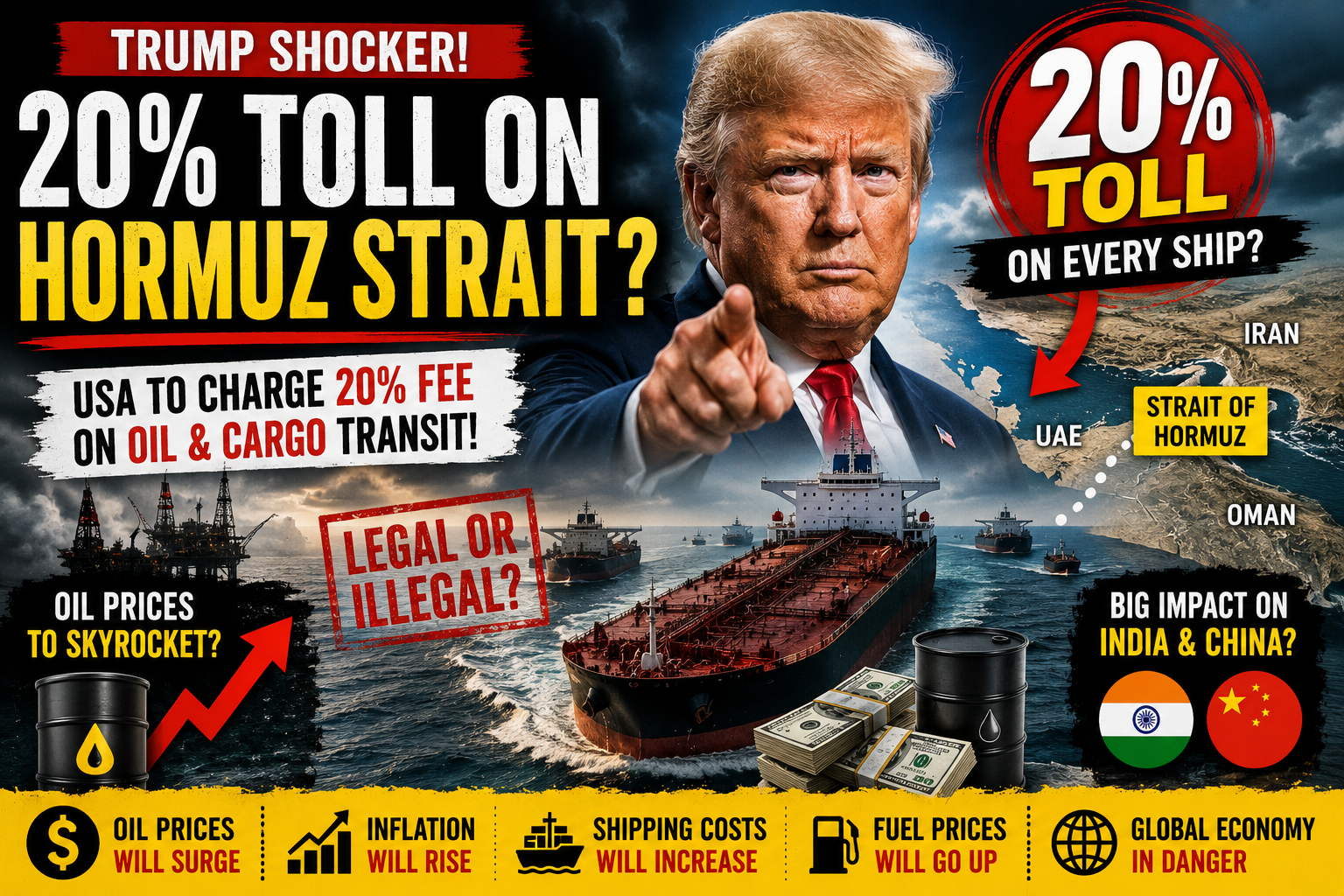
Imagine waking up to discover that the price of petrol, diesel, cooking gas, airline tickets and even groceries could rise—not because of a war, but because of a proposed 20% transit fee on one of the world’s most important oil routes.
Trump Strait of Hormuz has become one of the biggest international news stories after Donald Trump announced a proposal to impose a 20% transit fee on cargo passing through the strategic Strait of Hormuz. If implemented, the proposal could significantly affect global oil prices, inflation, international trade and major energy-importing countries like India and China.
If such a proposal were ever implemented, experts believe its impact could extend far beyond the Middle East, affecting oil prices, inflation, global trade and countries like India that depend heavily on imported crude oil.
So, what exactly is Trump’s Strait of Hormuz Toll proposal, and why is it generating so much controversy?
Let’s understand.
What Is the Strait of Hormuz?
The Strait of Hormuz is one of the world’s most strategically important maritime routes.
Located between Iran and Oman, it connects the Persian Gulf with the Arabian Sea and the Indian Ocean.
Nearly one-fifth of the world’s oil supply passes through this narrow waterway every day, making it one of the most important energy corridors on Earth.
Countries including Saudi Arabia, Iraq, Kuwait, Qatar and the UAE export massive quantities of crude oil through this route.
Any disruption here immediately affects global energy markets.
Trump Strait of Hormuz Proposal Explained
1. What Is Trump’s 20% Toll Proposal?
According to Trump’s announcement, the United States should serve as the security guarantor of the Strait of Hormuz.
His argument is that the US Navy spends billions of dollars protecting commercial shipping from regional threats.
Therefore, countries benefiting from this protection should reimburse the United States by paying a 20% transit fee based on the value of cargo.
For example,
If crude oil costs $100 per barrel, the additional fee would increase the effective cost to $120 per barrel.
Trump also suggested that Iranian vessels would not be allowed to use the route under this proposal, while other international ships could transit after paying the fee.
2. Why Is This Proposal So Controversial?
The proposal immediately triggered legal and diplomatic debates.
The biggest reason is simple:
The United States does not own or control the Strait of Hormuz.
The waterway is considered an international transit passage under the United Nations Convention on the Law of the Sea (UNCLOS).
Under international maritime law, commercial ships from all nations generally enjoy the right of transit passage through international straits.
Because of this, many legal experts argue that a third country without territorial sovereignty over the waterway cannot unilaterally impose transit charges.
If implemented, the proposal would almost certainly face significant international legal and diplomatic challenges.
3. Why Does the Strait of Hormuz Matter So Much?
The importance of the Strait of Hormuz cannot be overstated.
Every day it carries enormous quantities of:
- Crude oil
- LNG (Liquefied Natural Gas)
- Petroleum products
- Commercial cargo
Even minor disruptions in this route often trigger sharp movements in international oil prices.
This is why governments, investors and financial markets closely monitor developments in the region.
4. Could Oil Prices Rise Worldwide?
One of the biggest concerns surrounding Trump’s proposal is its potential impact on energy prices.
Following the announcement, crude oil prices moved above $80 per barrel, reflecting increased uncertainty in energy markets.
If transportation costs rise substantially, the consequences could include:
- Higher fuel prices
- Increased airline fares
- Rising shipping costs
- More expensive manufactured goods
- Higher food prices
- Increased inflation worldwide
Since energy is a key input for nearly every industry, sustained increases in oil prices often ripple across the global economy.
5. How Could India Be Affected?
India imports the majority of the crude oil it consumes.
A significant increase in Gulf oil prices could therefore affect:
- Petrol prices
- Diesel prices
- LPG cylinder costs
- Transportation expenses
- Manufacturing
- Inflation
If Gulf oil becomes significantly more expensive, buyers may seek alternative suppliers.
Some analysts have suggested that countries such as India could increase purchases from producers like Russia if Gulf supplies become less competitive.
However, the extent of any shift would depend on market conditions, supply availability and government policy.
6. Iran’s Response Added Another Twist
Instead of simply rejecting the proposal, Iranian officials suggested that if transit fees were to become part of the discussion, Iran itself could consider charging a much lower fee.
Some reports indicated figures in the range of 4% to 5% were mentioned as a “fair value.”
This exchange further intensified geopolitical tensions surrounding one of the world’s busiest maritime routes.
7. Can Trump’s Proposal Actually Be Implemented?
This is perhaps the biggest question.
Although the proposal attracted worldwide attention, turning it into reality would face several major obstacles.
These include:
- International maritime law
- Diplomatic opposition
- Resistance from shipping companies
- Possible legal challenges
- Opposition from major importing nations
- Questions over enforcement
Many experts believe implementation would be extremely difficult without broad international support.
Why This Matters for the World Economy
The Strait of Hormuz is much more than a narrow stretch of water.
It is one of the world’s economic lifelines.
Any uncertainty surrounding its operation has the potential to influence:
- Global inflation
- Stock markets
- Shipping costs
- Supply chains
- Energy security
- International diplomacy
Even announcements that raise questions about future access to the Strait can affect investor sentiment and commodity markets.
Key Takeaways
- Donald Trump announced a proposal to impose a 20% transit fee on cargo using the Strait of Hormuz.
- The proposal is based on the idea that countries should compensate the US for providing maritime security.
- Legal experts argue the proposal would face serious challenges under international maritime law.
- Higher oil transportation costs could increase inflation and affect economies worldwide.
- India, one of the world’s largest oil importers, could face higher energy costs if Gulf crude becomes more expensive.
- The proposal has also heightened geopolitical tensions involving Iran.
- Whether such a toll could actually be implemented remains highly uncertain.
Frequently Asked Questions (FAQ)
What is Trump’s Strait of Hormuz Toll proposal?
It is a proposal announced by Donald Trump suggesting that the United States charge a 20% transit fee on cargo passing through the Strait of Hormuz as compensation for providing maritime security.
Why is the proposal controversial?
Many legal experts argue that the United States has no sovereignty over the Strait of Hormuz, making unilateral transit charges difficult to justify under international maritime law.
Could India be affected?
Yes. If oil transportation costs increase significantly, India could experience higher fuel prices and inflation because it imports a large share of its crude oil.
Why is the Strait of Hormuz important?
It is one of the world’s busiest energy corridors, carrying a substantial share of globally traded crude oil and natural gas.