

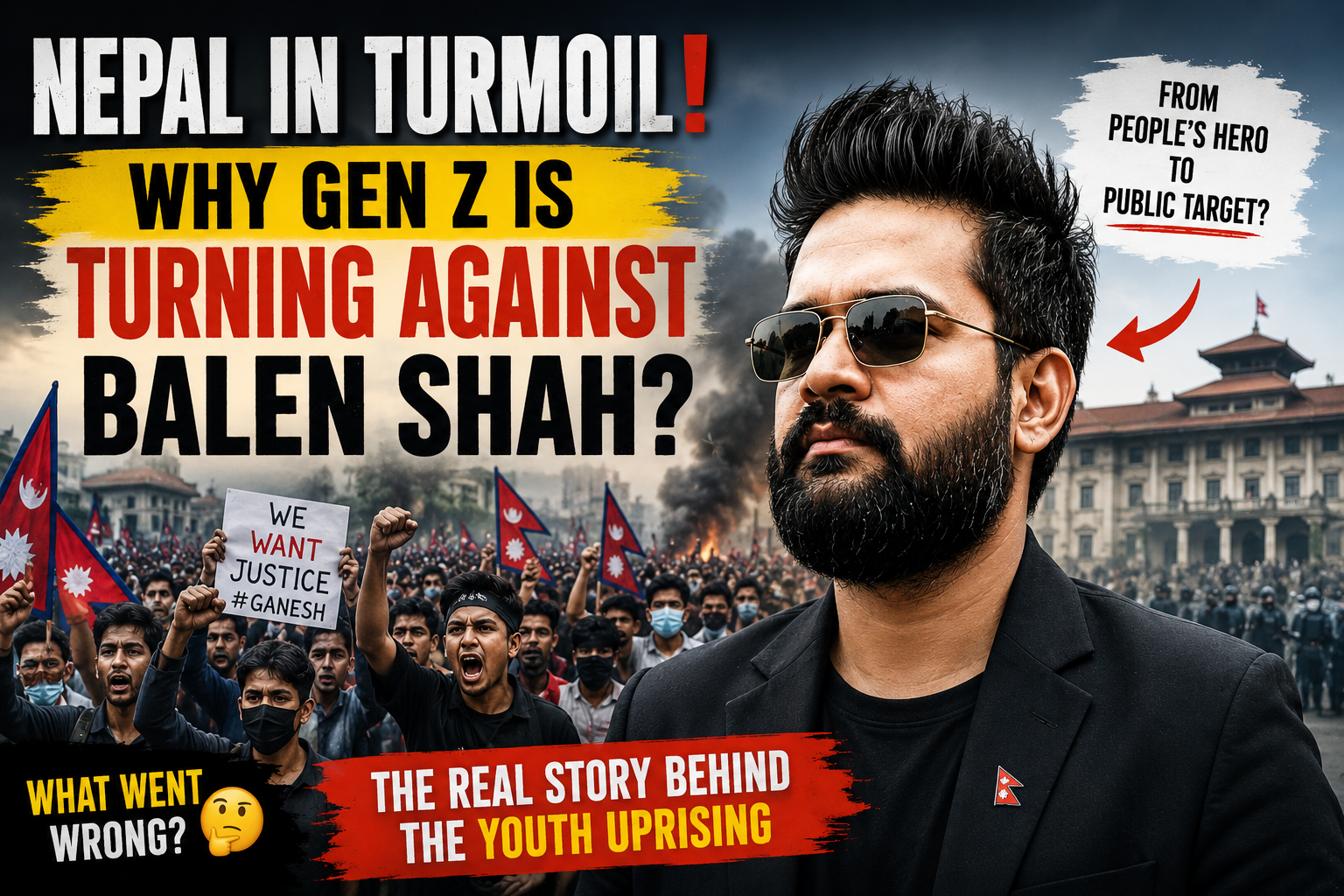
Why Nepal Gen Z is protesting has become one of the most searched political topics in South Asia. Thousands of young protesters have taken to the streets demanding justice, accountability and faster reforms from Prime Minister Balen Shah’s government.
Nepal is witnessing a fresh wave of political unrest as thousands of young people have taken to the streets to protest against Prime Minister Balen Shah—the very leader they overwhelmingly supported during the last election.
The demonstrations have raised an important question:
Why has Nepal’s Generation Z turned against the leader they once considered a symbol of hope and change?
The answer lies in a combination of public frustration, slow reforms, economic hardship, controversial government policies, and the tragic death of a young citizen that has become the face of the movement.
Who Is Balen Shah?
Before entering national politics, Balen Shah built an unconventional career.
He is known as:
- A Civil Engineer
- A Rapper
- An Independent Politician
His political journey began when he became the Mayor of Kathmandu.
During his tenure, he earned widespread appreciation for his administrative style and reform-oriented governance. Many people viewed him as:
- An anti-corruption reformer
- A technocrat
- A youth icon
- A leader willing to challenge Nepal’s traditional political system
His popularity rapidly increased among urban youth who were looking for an alternative to established political parties.
Why Nepal Gen Z is protesting has become… Experts believe Why Nepal Gen Z is protesting… Understanding Why Nepal Gen Z is protesting… The reasons Why Nepal Gen Z is protesting… Why Nepal Gen Z is protesting reflects… Many readers want to know Why Nepal Gen Z is protesting…
Why Did Nepal’s Youth Support Balen Shah?
For nearly two decades, Nepal experienced political instability.
Successive governments struggled to deliver stable governance, while citizens became increasingly frustrated with:
- Political corruption
- Nepotism
- Rising inflation
- High unemployment
- Slow economic growth
Thousands of educated young Nepalese were forced to seek employment abroad, especially in countries such as India and Malaysia.
At the same time, social media platforms like Facebook and TikTok enabled Nepal’s Generation Z to organize one of the country’s strongest youth-led political movements.
Their demands were simple:
- Clean politics
- Transparency
- Accountability
- Better governance
- Employment opportunities
Balen Shah became the face of this movement because he represented change rather than traditional politics.
Why Are People Protesting Now?
Although expectations were extremely high, many young voters believe that meaningful reforms have not arrived quickly enough.
Several issues have contributed to the growing dissatisfaction.
1. Death of Ganesh Nepali Became the Turning Point
The immediate trigger behind the recent protests was the death of Ganesh Nepali, a 25-year-old ride-share driver.
According to reports, he allegedly experienced severe humiliation during a police encounter over a fine.
Unable to cope with the incident, he set himself on fire outside Kathmandu’s Department of Passports and later died from his injuries.
For many young Nepalese, the tragedy symbolized:
- Police harassment
- Bureaucratic insensitivity
- Abuse of authority
- Failure of administrative reforms
His death has become the emotional centre of the current protests.
2. Allegations of Police Brutality
Following Ganesh Nepali’s death, protesters accused authorities of continuing heavy-handed policing.
Many demonstrators argue that despite electing a reform-oriented government, ordinary citizens continue to experience harassment and excessive use of power.
The protesters are demanding:
- Justice for Ganesh Nepali
- An independent investigation
- Greater police accountability
- An end to police brutality
3. Controversial Eviction Drives
The government has launched campaigns to remove illegal encroachments from roads, public land and riverbanks.
Officials argue that these actions are necessary for:
- Urban planning
- Traffic management
- Environmental restoration
However, critics say poor families are being displaced without proper rehabilitation.
Young protesters believe development should not come at the cost of vulnerable communities.
4. Slow Pace of Reforms
Balen Shah’s successful tenure as Kathmandu’s mayor created enormous national expectations.
Many young voters expected rapid improvements in areas such as:
- Digital governance
- Public services
- Urban cleanliness
- Waste management
- Better roads
- Public transportation
- Reduction in corruption
However, national-level reforms have proven far more complex than municipal administration.
The gap between expectations and reality has contributed significantly to public disappointment.
5. Continuing Economic Challenges
Economic frustration remains one of Nepal’s biggest concerns.
Young people continue to face:
- High unemployment
- Underemployment
- Rising living costs
- Limited career opportunities
Many still believe migration abroad is the only realistic path toward financial stability.
For Generation Z, political change has not yet translated into economic improvement.
What Are the Protesters Demanding?
The protesters have outlined several key demands:
- Justice for Ganesh Nepali
- Independent investigation into his death
- End to police brutality
- Immediate release of detained protesters
- Suspension of aggressive eviction drives
- Proper rehabilitation for displaced families
- Greater transparency in governance
- Faster institutional reforms
- Better economic opportunities for young people
Why This Protest Matters
The demonstrations reflect a broader challenge faced by many modern democracies.
Today’s young voters are highly connected through social media and expect governments to deliver visible results quickly.
Leaders who rise to power through promises of reform often face immense pressure to produce rapid improvements.
Nepal’s current situation highlights the difficulty of transforming public institutions that have developed over decades of political instability.
The Bigger Picture
Balen Shah’s rise represented a historic shift in Nepal’s politics.
He emerged as an outsider who inspired millions of young voters with promises of clean governance and systemic reform.
However, the current protests illustrate that winning public trust is only the beginning.
Maintaining that trust requires continuous transparency, accountability and measurable progress in addressing economic challenges and governance issues.
As Nepal continues its democratic journey, the relationship between its young citizens and political leadership is likely to play a defining role in shaping the country’s future.
Key Takeaways
- Balen Shah rose from rapper and civil engineer to become Nepal’s Prime Minister through strong youth support.
- Nepal’s Generation Z expected rapid reforms after years of corruption and political instability.
- The death of Ganesh Nepali became the immediate trigger for nationwide protests.
- Protesters are demanding justice, police accountability, rehabilitation for displaced families and faster reforms.
- The movement reflects broader concerns about governance, unemployment and transparency in Nepal.
FAQ
Why is Nepal’s Gen Z protesting against Balen Shah?
Young protesters are unhappy with the slow pace of reforms, ongoing economic problems, controversial eviction drives and the handling of the Ganesh Nepali case.
Who was Ganesh Nepali?
Ganesh Nepali was a 25-year-old ride-share driver whose death following an alleged incident involving police humiliation became the catalyst for nationwide protests.
Why was Balen Shah popular?
Balen Shah gained popularity through his work as Kathmandu’s mayor, where he built a reputation as an anti-corruption reformer, technocrat and youth leader.
What are the protesters demanding?
The protesters seek justice for Ganesh Nepali, an independent investigation, police accountability, rehabilitation for displaced families, faster reforms and greater government transparency.