

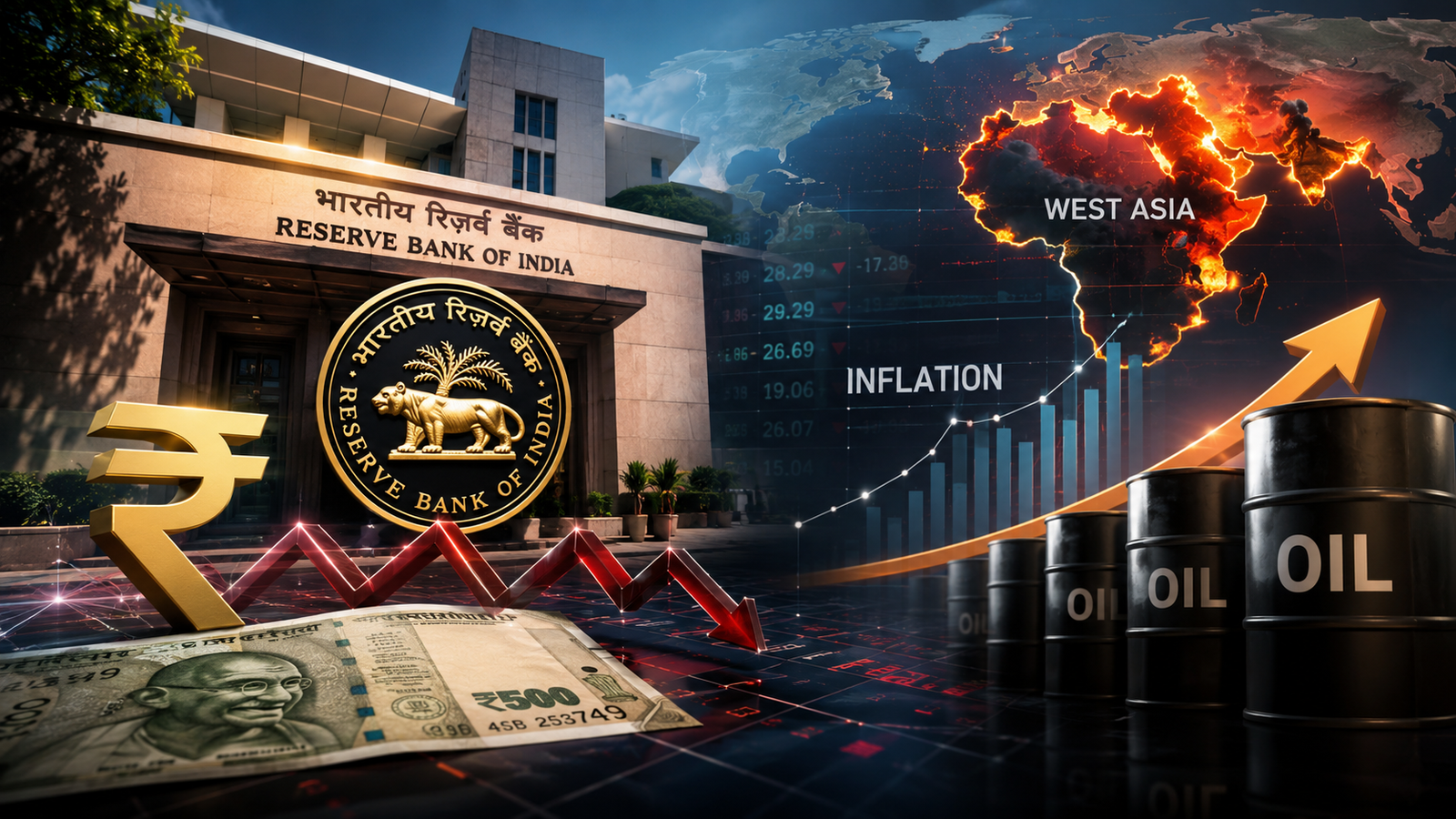
India is currently facing one of its most complex economic situations in recent years. On one hand, inflation is rising due to expensive crude oil and supply disruptions. On the other hand, economic growth is slowing down. Adding to the pressure, the Indian Rupee has been weakening against the US Dollar.
Amid these challenges, the Reserve Bank of India (RBI) has decided to keep the repo rate unchanged at 5.25%. While many expected an interest rate hike to control inflation, the central bank chose a different strategy.
Why did the RBI take this decision? What role is the ongoing West Asia crisis playing in India’s economy? Is India facing the risk of stagflation?
Let us understand the complete picture.
Why Did RBI Keep the Repo Rate Unchanged?
Normally, when inflation rises, central banks increase interest rates to reduce spending and control prices. However, the RBI believes the current inflation is largely driven by supply-side shocks rather than excessive consumer demand.
This means that raising interest rates would not solve the root problem.
The central bank has therefore adopted a wait-and-watch approach while maintaining a neutral monetary policy stance.
Current Economic Indicators
- Repo Rate: 5.25%
- Inflation Forecast: 5.1%
- Previous Inflation Forecast: 4.6%
- GDP Growth Forecast: 6.6%
- Previous GDP Growth Forecast: 6.9%
The RBI believes that an unnecessary rate hike could further slow economic growth without effectively reducing inflation.
Understanding Cost-Push Inflation
The present inflationary pressure in India is mainly a result of cost-push inflation.
Cost-push inflation occurs when the cost of production increases due to higher prices of essential inputs such as fuel, transportation and raw materials.
Currently, two major factors are driving this inflation:
1. West Asia Crisis
The ongoing geopolitical tensions in West Asia have disrupted global energy markets and increased uncertainty regarding crude oil supplies.
2. Weak Monsoon Concerns
India’s agriculture sector remains heavily dependent on monsoon rainfall. Lower-than-normal rainfall could reduce agricultural output and increase food prices across the country.
Because these problems originate from supply shortages, increasing the repo rate would have limited effectiveness.
How the West Asia Crisis Is Affecting India
The biggest economic threat arising from the West Asia conflict is the risk to global oil supplies.
The Importance of the Strait of Hormuz
A significant portion of global crude oil passes through the Strait of Hormuz, one of the world’s most important maritime trade routes.
Any disruption in this region immediately affects global oil prices.
Since India imports a large share of its crude oil requirements, higher international prices directly impact the Indian economy.
Three Rounds of Inflation Triggered by Oil Prices
First Round: Direct Fuel Price Increase
Higher crude oil prices immediately raise the prices of:
- Petrol
- Diesel
- LPG Cylinders
- Aviation Fuel
Second Round: Rising Transportation Costs
As fuel becomes more expensive:
- Freight charges increase
- Logistics costs rise
- Food transportation becomes costlier
- Manufacturing expenses increase
Third Round: Economy-Wide Price Increase
Businesses pass these higher costs to consumers by increasing prices of goods and services.
The result is broad-based inflation across the economy.
Why Is the Rupee Falling?
The depreciation of the Indian Rupee is closely linked to rising oil prices.
When oil becomes more expensive:
- India needs more US Dollars to pay for imports.
- Demand for Dollars rises sharply.
- Outflow of foreign currency increases.
- Pressure on the Rupee intensifies.
As a result, the Rupee weakens against the Dollar.
A weaker currency further increases import costs, creating a vicious cycle of inflation.
Why RBI Is Focusing on Dollar Inflows Instead of Rate Hikes
Instead of raising interest rates, the RBI is trying to strengthen the Rupee by attracting more foreign capital into India.
This strategy aims to increase the supply of US Dollars in the domestic market.
Tax Benefits for Foreign Investors
The government and RBI have introduced tax incentives for foreign investors purchasing Indian government bonds.
By removing long-term capital gains tax obligations for eligible foreign investors, India becomes a more attractive destination for global capital.
As foreign investors bring money into India, the supply of Dollars increases, helping stabilize the Rupee.
Expansion of the Fully Accessible Route (FAR)
The RBI has expanded access to long-term Indian government bonds.
Foreign investors can now participate more easily in:
- 15-year bonds
- 30-year bonds
- 40-year bonds
This encourages long-term capital inflows into India.
Easier Rules for NRIs and Overseas Investors
The RBI has also simplified regulations for:
- Non-Resident Indians (NRIs)
- Overseas Citizens of India (OCI)
- Foreign Residents
These reforms aim to attract greater investment into Indian financial markets.
What Are Concessional Forex Swaps?
One of the RBI’s innovative measures is the use of concessional forex swaps.
How Forex Swaps Work
- Domestic banks holding excess US Dollars transfer those Dollars to the RBI.
- In return, the RBI provides Indian Rupees.
- The transaction is temporary and will be reversed later.
Why This Helps the Rupee
This mechanism immediately increases Dollar availability in the financial system.
More Dollar supply helps reduce pressure on the Rupee and stabilizes currency markets.
How a Weak Monsoon Can Increase Inflation
Agriculture remains highly dependent on rainfall in India.
If rainfall remains below normal:
- Crop production falls.
- Food supply declines.
- Prices of vegetables, cereals and other agricultural products rise.
This creates another wave of cost-push inflation.
Because food inflation directly impacts millions of households, the RBI is closely monitoring monsoon forecasts before taking any major policy decision.
Is India Facing the Risk of Stagflation?
One of the biggest concerns among economists is the possibility of stagflation.
What Is Stagflation?
Stagflation occurs when:
- Economic growth slows down.
- Inflation remains high.
- Employment opportunities weaken.
This combination is particularly dangerous because traditional policy tools become less effective.
Why Economists Are Concerned
Several warning signs are currently visible:
Slower GDP Growth
India’s GDP growth forecast has been reduced from 6.9% to 6.6%.
Rising Inflation
Inflation projections have increased from 4.6% to 5.1%.
Weakening Rupee
The Indian currency has come under significant pressure due to expensive imports and global uncertainty.
Expensive Crude Oil
Higher energy costs continue to affect households and businesses alike.
While India has not entered stagflation, the current economic environment requires careful monitoring.
RBI’s Neutral Stance: A Strategic Balancing Act
The RBI’s latest decision reflects a delicate balancing act.
Increasing interest rates could damage growth.
Reducing interest rates could worsen inflation.
Therefore, maintaining the repo rate at 5.25% allows policymakers to remain flexible while monitoring:
- Global oil prices
- West Asia developments
- Rupee movements
- Foreign investment flows
- Monsoon performance
- Domestic inflation trends
This strategy provides the RBI with room to respond quickly if economic conditions deteriorate further.
Conclusion
India’s economy is navigating a difficult period marked by geopolitical tensions, rising oil prices, inflationary pressures and a weakening Rupee. The RBI’s decision to keep the repo rate unchanged at 5.25% reflects its belief that current inflation is largely supply-driven and temporary rather than demand-driven.
Instead of increasing borrowing costs, the central bank is focusing on stabilizing the Rupee through foreign capital inflows, bond market reforms and forex management measures.
The coming months will be crucial. The trajectory of crude oil prices, developments in West Asia and the performance of the monsoon will determine whether inflation eases or whether the threat of stagflation becomes a more serious concern for the Indian economy.