

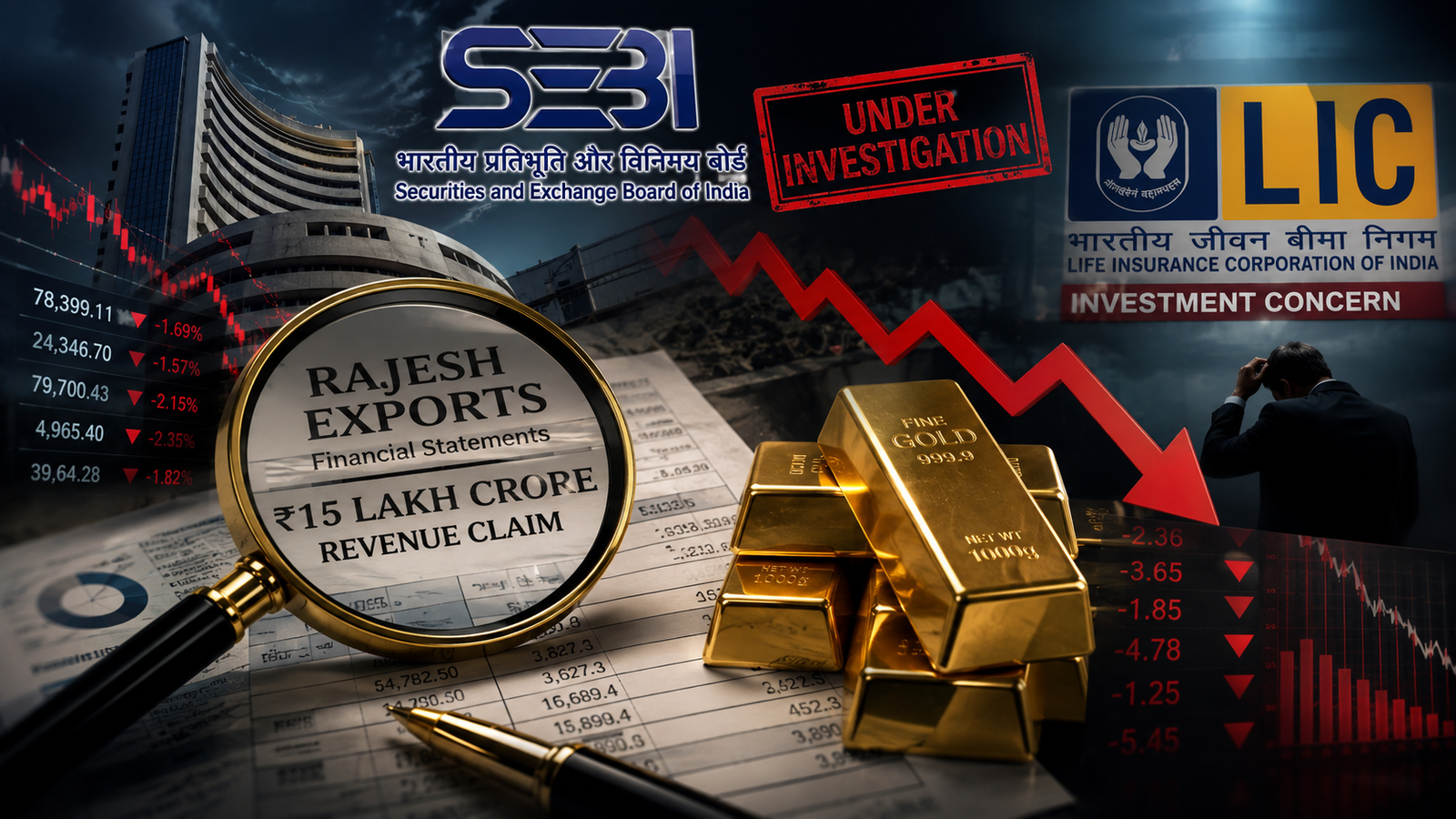
India’s financial markets are witnessing one of the most closely watched corporate investigations in recent years. Gold giant Rajesh Exports, once celebrated as one of India’s biggest precious metal companies, is now facing intense scrutiny from the Securities and Exchange Board of India (SEBI).
At the heart of the controversy lies an astonishing figure—₹15 lakh crore in reported revenues linked primarily to the company’s Swiss subsidiary, Valcambi. SEBI is investigating whether these revenues were adequately supported by verifiable financial records and whether investors received a true picture of the company’s financial health.
The issue has become even more sensitive because Life Insurance Corporation of India (LIC), which manages the savings of millions of policyholders, holds a significant stake in the company.
As Rajesh Exports’ share price continues to collapse and regulatory scrutiny intensifies, investors are asking a crucial question: Is this merely a compliance failure, or does it point to deeper corporate governance concerns?
What Triggered the SEBI Investigation?
The investigation reportedly began following shareholder complaints and concerns regarding the company’s financial disclosures.
SEBI’s primary concern is not that ₹15 lakh crore has been stolen or that a proven scam has occurred. Instead, regulators are questioning whether Rajesh Exports adequately documented and substantiated the enormous revenues reported in its financial statements.
According to the allegations, the company failed to provide sufficient supporting records for revenues linked to its Swiss subsidiary, Valcambi.
The ₹15 Lakh Crore Revenue Mystery
One of the most striking aspects of the investigation is the company’s claim that nearly 97% to 99% of its revenue originated from Valcambi, one of the world’s largest gold refining operations.
Over a five-year period, Rajesh Exports reportedly recorded approximately ₹15 lakh crore in revenues connected to the subsidiary.
SEBI’s concern is straightforward:
- Where is the supporting documentation?
- Can auditors independently verify these transactions?
- Do the reported revenues reflect genuine business activity?
Regulators argue that without adequate evidence, investors cannot properly assess the true financial position of the company.
Why Revenue Verification Matters
Publicly listed companies are required to maintain complete transparency.
If a company reports enormous revenues without providing sufficient documentation, several risks emerge:
Misleading Financial Performance
Large revenue figures can create an impression of rapid growth and business success.
Artificial Market Valuation
Higher reported revenues may contribute to a larger market capitalization and attract investors who believe the company is expanding aggressively.
Investor Decision-Making Risks
Retail investors often rely on published financial statements when making investment decisions.
If financial disclosures are incomplete or difficult to verify, investors may unknowingly take on greater risk.
Questions Over a ₹1,000 Crore African Gold Mine Investment
The investigation is also examining a reported investment of approximately ₹1,000 crore in African gold mining assets.
SEBI has reportedly raised concerns regarding:
- Lack of valuation reports
- Insufficient documentation
- Missing supporting financial evidence
Without proper records, regulators find it difficult to independently assess the true value of these investments.
Allegations of Fund Routing Through Personal Accounts
Perhaps the most serious corporate governance issue involves allegations that company funds may have been routed through personal accounts connected to promoters.
Corporate governance principles require a clear separation between:
- Company funds
- Promoter finances
- Personal investments
Any blurring of these boundaries raises significant concerns regarding transparency, accountability and shareholder protection.
SEBI is therefore examining whether listed company resources were handled in a manner inconsistent with expected governance standards.
The ₹11,400 Crore Transaction Questions
Another major focus of the investigation involves transactions worth approximately ₹11,400 crore.
Regulators are examining allegations that certain personal derivative trading activities may have been reflected within company records as official business transactions.
Due to incomplete documentation, investigators are attempting to determine whether these entries represented genuine commercial activity.
Large Trade Receivables Raise Further Questions
SEBI is also reviewing unusually large trade receivables.
Trade receivables represent money owed to a company by customers for goods already sold.
When receivables remain outstanding for long periods, questions naturally arise:
- Will the money be collected?
- Are the sales genuine?
- Is the company’s financial position being accurately represented?
Long-pending receivables often become an important area of scrutiny during forensic audits.
Chairman Rajesh Mehta’s Defense
Chairman Rajesh Mehta has strongly disputed the concerns.
According to his defense, regulators focused only on the standalone financial statements of Rajesh Exports while ignoring the consolidated accounts of the entire corporate group.
What Is the Difference?
Standalone Accounts
These show only the financial performance of the parent company.
Consolidated Accounts
These combine the financial results of the parent company and all subsidiaries into a single financial statement.
Mehta argues that because Valcambi is one of the largest gold refiners globally, its massive operations naturally generate extraordinarily high revenues.
According to his explanation, Valcambi reportedly refined around 3,000 tonnes of gold between FY2021 and FY2025, making large revenue figures reasonable in the context of the business.
Why LIC’s Involvement Has Become Controversial
One of the most politically sensitive aspects of the story is the involvement of LIC.
As of March 2026, LIC reportedly owns more than 10% of Rajesh Exports.
This has triggered intense debate because LIC manages the savings and insurance premiums of millions of Indians.
Why Investors Are Concerned
Private Funds Stayed Away
Many private mutual funds reportedly avoided Rajesh Exports for years due to concerns regarding governance and transparency.
LIC Increased Exposure
Despite falling share prices, LIC continued increasing its stake over the past several years.
Public Confidence Effect
Many retail investors viewed LIC’s presence as a sign of safety.
As a result, some investors may have assumed the company had undergone rigorous institutional scrutiny and was therefore a relatively secure investment.
Now that SEBI’s investigation has intensified, questions are being raised regarding whether important warning signs were overlooked.
Rajesh Exports Share Price Crash
The stock market performance has been devastating.
Over the last five years:
- The stock has fallen more than 80%.
- Share prices that once traded above ₹800–₹900 have dropped below ₹100.
- The stock has frequently hit lower circuits.
- Selling pressure remains extremely high.
The collapse has wiped out substantial shareholder wealth and intensified concerns surrounding the company’s disclosures.
Is This a Scam?
At present, it is important to understand a critical distinction.
SEBI has not concluded that a ₹15 lakh crore fraud or theft has occurred.
The current allegations primarily relate to:
- Lack of documentation
- Inadequate disclosures
- Compliance failures
- Corporate governance concerns
- Verification of reported transactions
The final outcome will depend on the results of forensic investigations and regulatory proceedings.
What Happens Next?
SEBI has already taken interim action by restricting Chairman Rajesh Mehta from participating in the securities market until further proceedings conclude.
Meanwhile, forensic scrutiny of the company’s records is expected to continue.
Investigators will seek answers to several key questions:
- Were the reported revenues genuine?
- Can transactions be independently verified?
- Were disclosure standards properly followed?
- Were investors given a complete and accurate picture of the company’s finances?
The answers could have significant implications not only for Rajesh Exports but also for corporate governance standards across India’s capital markets.
Final Verdict
The Rajesh Exports controversy has evolved into one of the most significant corporate governance stories in recent years. With questions surrounding ₹15 lakh crore in reported revenues, a collapsing share price, concerns over promoter transactions, and LIC’s substantial exposure, the investigation has attracted nationwide attention.
For investors, the case serves as a powerful reminder that strong revenues alone are never enough. Transparency, governance, documentation and accountability remain the true foundations of investor confidence.
As SEBI’s forensic examination progresses, the market will be watching closely for answers that could determine the future of one of India’s most talked-about gold companies.