

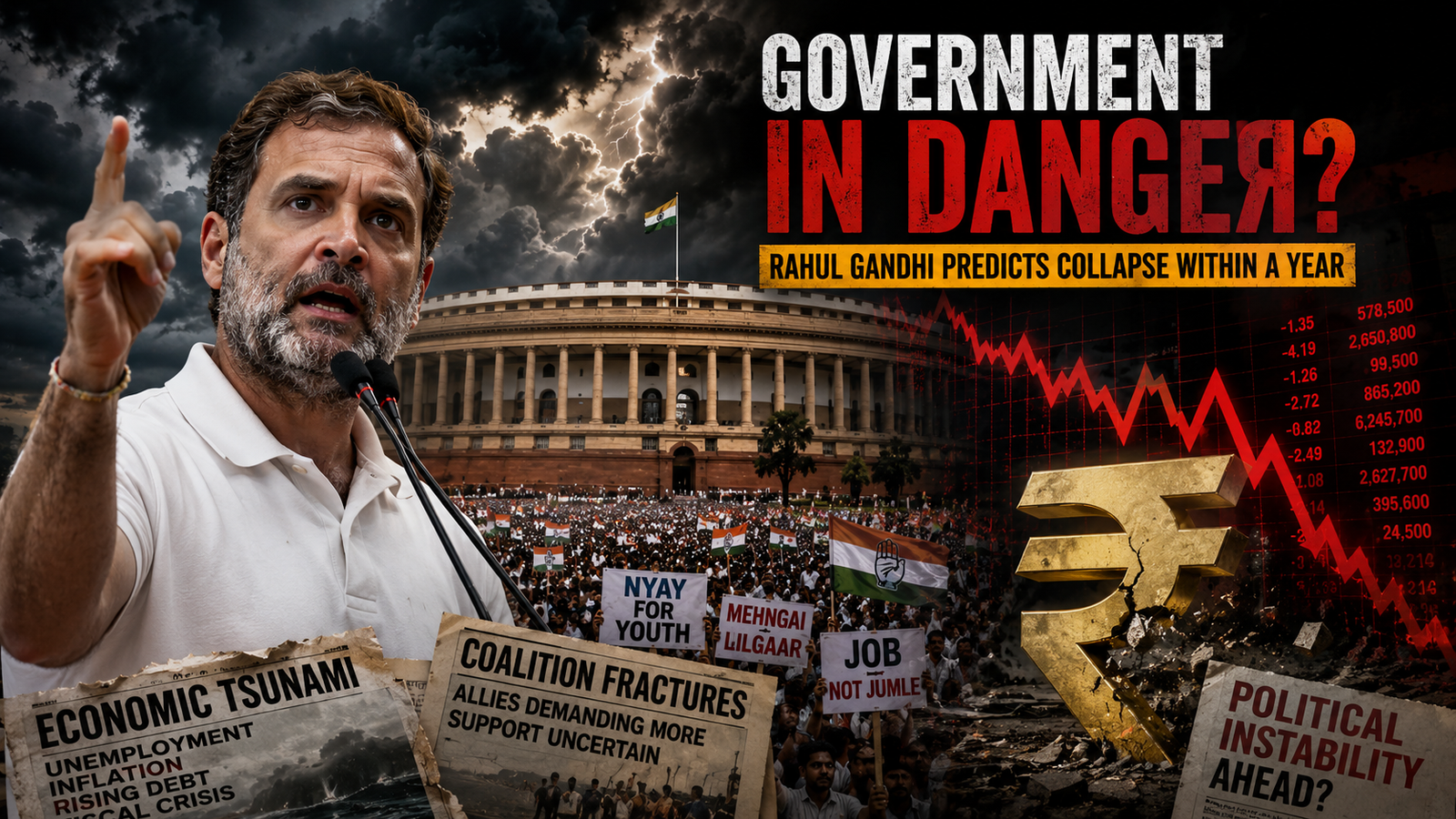
Indian politics has once again entered a heated phase after Leader of Opposition Rahul Gandhi made a bold prediction: the current NDA government could face a major political crisis within a year.
Rahul Gandhi not only questioned the stability of the ruling coalition but also warned of what he described as an impending “economic tsunami” that could shake the country politically and economically.
His remarks have triggered intense debate across political circles, financial markets, and social media. Supporters see the warning as a realistic assessment of emerging challenges, while critics accuse him of spreading unnecessary fear and uncertainty.
So, what exactly is Rahul Gandhi predicting, and why has it become such a major political issue?
Why Does Rahul Gandhi Believe the Government Is Vulnerable?
According to Rahul Gandhi, three major factors could put the current government under significant pressure in the coming months.
1. Coalition Politics and Dependence on Allies
Unlike previous terms, the BJP did not secure a standalone majority in the 2024 Lok Sabha elections.
With 240 seats, the party depends heavily on key allies such as the TDP and JD(U) to maintain its parliamentary majority.
Rahul Gandhi argues that coalition governments in India have historically been vulnerable to internal disagreements and shifting political loyalties.
He points to past examples where coalition governments eventually collapsed after alliance partners withdrew support, including governments led by Morarji Desai, I.K. Gujral and Atal Bihari Vajpayee.
His argument is that managing diverse regional allies becomes increasingly difficult when political and economic pressures intensify.
The Meaning Behind the “Economic Tsunami”
One of the most discussed aspects of Rahul Gandhi’s speech was his warning about an “economic tsunami.”
The term does not refer to a sudden event but rather a gradual buildup of economic stress that remains hidden until it eventually creates a larger crisis.
According to his argument, several warning signs are already visible.
Rising Youth Unemployment
High unemployment among educated young people remains a significant concern.
Job creation has not kept pace with the growing number of graduates entering the workforce each year, creating frustration among large sections of the population.
Exam Controversies and Public Anger
Issues surrounding competitive examinations, including controversies involving NEET and recruitment processes, have further fueled dissatisfaction among students and job seekers.
Slowing Consumer Demand
Economists have increasingly pointed to weak consumption growth as a concern.
Many households are facing pressure from rising living costs, while income growth remains uneven.
Growing Economic Inequality
The gap between high-income and low-income groups continues to be a subject of debate, with critics arguing that the benefits of economic growth are not reaching everyone equally.
Global Risks That Could Affect India
Rahul Gandhi also highlighted several international developments that could impact India’s economy.
These include:
- Russia-Ukraine conflict
- Tensions involving the United States and Iran
- Instability in West Asia
- Global supply chain disruptions
- Rising crude oil prices
If oil prices surge significantly, India’s import bill could increase sharply, putting pressure on inflation, government finances and economic growth.
Is There Internal Friction Within the BJP?
Another controversial part of Rahul Gandhi’s claim relates to alleged dissatisfaction within the BJP itself.
He suggested that internal pressures and factional differences may be growing beneath the surface.
According to Gandhi, opposition leaders are receiving signals that not everyone within the ruling establishment is fully aligned.
He even hinted that leadership changes could become a possibility if political challenges intensify.
However, no specific evidence has been publicly presented to support these claims.
What Did Rahul Gandhi Mean by “Extraordinary Political Measures”?
Perhaps the most controversial aspect of his remarks was the suggestion that the government could resort to “extraordinary political measures” if faced with severe political and economic pressure.
Many political observers interpreted this as an indirect reference to the possibility of Emergency-like actions.
The statement immediately sparked controversy because the Emergency imposed between 1975 and 1977 remains one of the most debated chapters in Indian political history.
Some analysts believe Gandhi was attempting to turn a historical criticism often directed at Congress back toward the BJP.
BJP’s Response: ‘Selling Panic’
The BJP strongly rejected Rahul Gandhi’s prediction.
Party leaders accused him of deliberately creating fear and uncertainty for political gain.
According to the BJP, repeatedly predicting economic collapse and government instability can damage investor confidence and create unnecessary anxiety in financial markets.
Critics argue that modern economies are highly dependent on expectations. If investors begin believing that a major crisis is imminent, investment decisions may slow down, markets may become volatile, and economic sentiment could weaken.
This is why BJP leaders have described such warnings as an attempt to “sell panic.”
Can Political Predictions Affect Financial Markets?
Financial experts often note that investor confidence plays a crucial role in economic stability.
When influential political leaders publicly predict economic turmoil or government instability, markets sometimes react even before any actual crisis emerges.
As a result, debates around economic narratives are often as important as the underlying economic data itself.
This is one reason why Rahul Gandhi’s remarks have received significant attention beyond the political arena.
Is India Really Heading Toward a Crisis?
At present, there is no conclusive evidence that the government is on the verge of collapse or that India is heading toward an economic crisis of the magnitude described.
Rahul Gandhi’s comments represent a political forecast rather than a proven fact.
Supporters argue that he is highlighting genuine risks that deserve attention.
Critics argue that the prediction is politically motivated and lacks concrete evidence.
The reality will likely depend on several factors:
- Economic performance over the next year
- Employment trends
- Inflation and oil prices
- Stability of coalition partners
- Global geopolitical developments
- Public sentiment ahead of future elections
Conclusion
Rahul Gandhi’s prediction that the current government could face a major crisis within a year has reignited debate about coalition politics, economic challenges, and the future of Indian governance.
Whether his warning proves accurate or not, it has succeeded in shifting public attention toward important questions about employment, economic growth, political stability and India’s long-term direction.
For now, the claim remains a political forecast—not an established reality. But as economic and political pressures evolve, the coming months will determine whether this prediction becomes a footnote in political rhetoric or a significant moment in India’s political history.